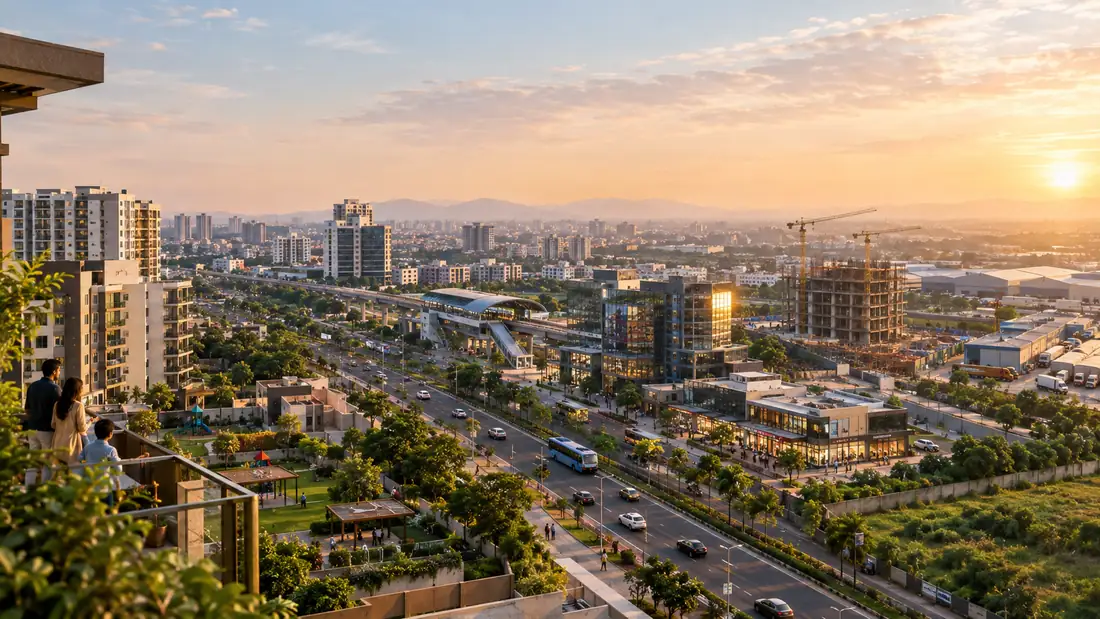
For a long time, when someone mentioned India’s growth markets, they would immediately think about the big cities.
It is not wrong to think that way, because the capital cities represent the kind of opportunity that draws people from all over the country: jobs, commerce, institutions, and other essentials that make life worth living.
That said, there is a different set of reasons why the second- and third-tier cities are witnessing a significant change.
As the metro cities continue to grow, become expensive, and congested, some elements that were once exclusive to them start finding their place elsewhere.
Manufacturing and warehousing can take advantage of more accessible land and logistics. The consumer base in smaller cities rises substantially, which in turn lowers their entry barriers in certain sectors. Additionally, the same cannot be said for metro cities, where the demand often outpaces the supply, leaving little room for middle-class consumers.
It is this confluence of events that leads to the change in fortunes of the second- and third-tier cities.
Why Are Companies Looking Beyond the Metros?
At the most basic level, businesses do not look to locate in a particular place because it has the best commercial real-estate on offer.
Sometimes, businesses require affordable land or labor, warehousing space, accessibility to logistics hubs, or proximity to either the workforce or the consumer base.
When some of these inputs are available in smaller centers, it encourages companies to set up there.
Manufacturing and warehousing are obvious beneficiaries of such a scenario, but so are service businesses.
Once there is enough economic activity in a city, it starts to generate more reasons why people should consider locating there too.
Is Lower Cost The Real Pulling Factor?
Lower costs are always a draw, but on their own, they may not be enough.
Unless the affordability is paired with some other factor, such as accessibility to other resources, it might not be enough to induce a company to relocate.
Same goes for residential affordability: unless there is some other reason, a lower price point alone will not cause demand to spike.
It would help if the relative cheapness was accompanied by improved connectivity, a larger workforce, or higher consumer spending power.
It is the presence or otherwise of these additional factors that determine the extent to which an economy is attractive.
The next big question then is, what are the reasons why companies are drawn towards these emerging markets?
What Happens When Employment Opportunities Emerge?
It is this push for employees that has a cascading effect down the line – and has tremendous impact on real-estate demand.
Whenever there is an economic activity that generates employment, it causes a ripple effect: people want to live closer to their workplace, and they require various amenities and services within easy reach.
Those who can afford to buy property are inclined to do so, whereas those who cannot, will look for rental options.
Even the ancillary service providers such as grocery stores, eateries, healthcare and education facilities, and others will also look to locate closer to where people live. Hence, in many ways, it is the employment opportunities that dictate the direction of real-estate demand in any given region.
Any new project, industry, commercial complex, or logistics facility can generate employment. However, when there is a substantial increase, it can have a considerable impact on how the local market develops.
Why Is Connectivity Increasing The Appeal Of Smaller Cities?
Improved connectivity always plays a role in altering the economic structure of a given region.
A smaller city does not need to become a major metro to benefit from enhanced connectivity.
It only has to become more connected to the nearest large economic center.
That, in and of itself, is enough to improve its prospects considerably.
Improved transport links mean that the practical market size increases manifold: businesses can serve more customers, employ more people, and conduct their operations with far greater efficiency.
The same goes for individuals, who can commute to and from work with greater ease, and for goods, which can be transported over longer distances for better value extraction.
It is, therefore, not surprising that investors always look to capitalize on improved connectivity.
It highlights the importance of the location of a smaller city, because a Tier-2 or Tier-3 city that is strategically placed near a major economic center will have a far better growth outlook than one that is not.
So, when we hear that connectivity is going to improve, the most important question to ask is, what is a city being connected to? We look at this in more detail in From Connectivity to Demand: How Locations Grow.
Are Consumers Too Becoming A Reason Why Companies Are Considering Smaller Markets?
They most certainly are, and this factor is often overlooked.
As far as businesses are concerned, smaller cities and towns are not only places where people reside but also potential consumers.
Many of these people also live within close proximity to the primary economic hubs where big-ticket items are purchased or where discretionary spending takes place.
With higher disposable incomes and increased digital penetration, consumer behavior is also changing: people are buying more, and they are buying from a far wider range of sources.
This has allowed many companies to expand their footprint outside of the major metro regions, because they can access a reasonable consumer base.
A company does not always have to wait for a city to develop before it can enter the fray: if there is a prospective customer, it is always beneficial to reach out and grab them while they are still available.
As more companies start targeting local consumers, the economic makeup of a region also changes accordingly.
Does It Mean That Every Tier 2 Or Tier 3 City Is Set To Grow?
It also has to be understood that while this growth narrative is an overarching theme, it does not apply to every single city.
Certain Tier-2 and Tier-3 cities may not necessarily benefit from the outlined trends.
Some of them might have strong industries but be lacking in the key infrastructure, or have the necessary amenities but not enough employment opportunities, or a decent population base but not enough in terms of new economic activity to drive demand upwards.
At the same time, some cities can attract real-estate developers based on predicted demand, but that does not always mean that the supply-demand equation will immediately favor the buyer.
It has to be remembered that while the tier indicates the size category, it does not indicate the growth prospects in a city.
What Should Someone Be Looking For?
Someone looking into the potential of a Tier-2 or Tier-3 city should not begin with the question, “Which city should I consider?” but rather ask “What is driving change there?”
It is however necessary to ask a few specific questions before buying any land or real-estate in the city. They include:
- Is there employment being generated in this city?
- Are there businesses being launched or relocated to this city?
- What is the city connected to?
- Is the resident population rising owing to the aforementioned factors?
- Are services and commerce also expanding?
- Is private investment following the public investment?
- Most importantly, is the supply keeping up with demand, or is it lagging behind?
It does not always have to have an entirely positive answer to these questions.
As previously stated, some of the factors that contribute to the appeal of a growing city come with a degree of risk as well.
However, it is important to see how the overall outlook of a region is progressing.
If employment is rising, companies are relocating, connectivity is improving, and local consumption is rising, then it is safe to say that a city is undergoing substantial change.
That, in itself, is a sign that the market will soon enter a new phase.
Why Does It Matter So Much To Know What Stage A Regional Market Has Reached?
There is great allure in the idea of the next big thing, and the early mover advantage always appeals to many. It is therefore not surprising that whenever something new emerges, there is always a scramble to get there first. However, in many ways, it is far more important to understand the evolution of a market at a given point in time.
There will always be new developments that promise to bring in higher-quality infrastructure or better commercial opportunities, as well as increased residential demand.
As such, there will always be a certain level of noise and speculation about what will drive the market forward.
For someone looking to buy into the market, it is necessary to cut through the noise and understand exactly where a regional market is at any given time.
That way, even if the next big thing has not emerged yet, the person has a strong enough position to be able to take advantage of the opportunities as and when they arise.
It is this ability to identify the shift that makes the entire exercise worthwhile.
That is why the conversation around Tier-2 and Tier-3 cities is so fascinating: not because small cities are going to overtake big ones, but because emerging markets are poised to play a far bigger role in India’s economic future than has been traditionally expected.
At Om Shiv Buildvision, this is the lens we bring to every corridor around Alwar. If you want a second opinion on a market you are considering, our team is one message away.