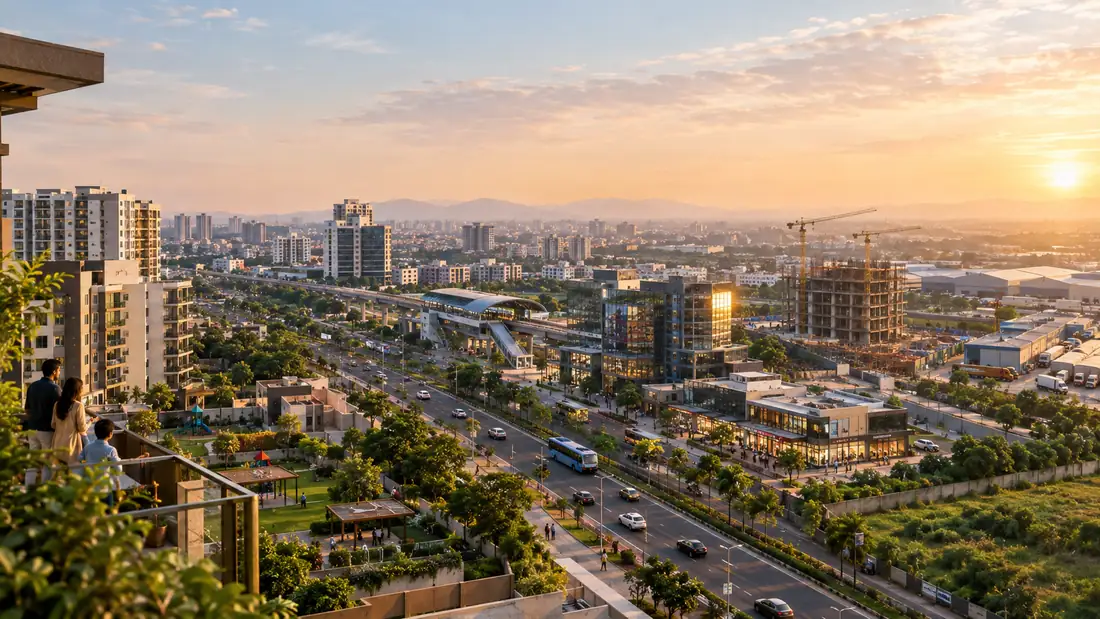
Whenever the discussion begins, the emphasis is usually placed on what the growing region typically has. New roads are to be built, industries announced, a new corridor defined, and land put up for cheap.
All of the above may well be justified, but when it comes to the actual location analysis, there is one step that should always be taken before everything else – read the signs collectively. You may not always have the luxury of waiting for offices to be leased, houses occupied and shops filled before making a decision, by which point the market will have taken notice.
Therefore, a more interesting question to ask is if the signs point to growing value and demand. The emphasis is on signs, which means a combination of what is to come, what has started, as well as what surrounds the development in question.
What Makes the Signs Point to a Growing Region?
Growth is rarely immediate, and there will always be signs preceding it.
A road is to be built, big companies have acquired land, the industrialisation of the region has begun, housing developments announced, government related investments made due to public want and need in a certain corridor.
None of the above necessarily point to a region taking off, but you also cannot dismiss them out of hand due to the absence of certain developments elsewhere.
The timing is relevant, as is the understanding that an emerging market will always appear to have fewer businesses, vacant buildings, paused developments and lower overall occupancy than one that has taken off.
It is for you to decide if the change has begun.
What Else Is Likely to Come Along With the Developments?
Infrastructure is frequently the easiest sign to spot, but it is also, more often than not, only the beginning.
Ask yourself what the new connection is likely to enable.
Does it provide access to a centre of employment, an industrialised region, does it facilitate the transport of goods, make it easier for people to live in another region and commute, or does it serve another purpose?
The next logical step following the road development is frequently business.
Not necessarily a flood of businesses, but specific sectors taking note of the changing circumstances and being willing to invest.
Most importantly, private investment, which will always come with due diligence.
They will weigh the current logistics and projected developments, the potential customer base, and the projected workforce availability.
You may, therefore, want to focus less on the number of businesses that have chosen the region, and more on what they bring with them in terms of capabilities and customers.
What Can New Housing Say About the Region?
The importance of residential development should not be understated, and the same goes for context.
Their very presence frequently means that a developer has done their homework and seen potential, which is always an intriguing sign as to where things are likely to go.
That potential may take numerous shapes and forms.
The region may be becoming more accessible, jobs may be coming, other residential buildings may be developed, a specific service may have drawn people in.
What other offerings, facilities, or services are due to become available to residents? You are looking at a region that has potential, and the wants and needs of the people that will occupy it are always a good indicator of where things are headed.
What Can the Availability of Services Say About the Region?
People are frequently attracted to opportunities, and services often cater to specific demographics.
New schools, hospitals, shops, or restaurants, therefore, always speak to a demand that has been addressed.
At the same time, you should always remember that services frequently take longer to develop. Some regions will see large-scale developments take shape before any services are considered, which will then be installed to meet the needs of businesses and residents alike. This makes the mere appearance of shops and other services a strong sign in itself, as it speaks to a developing population.
Focus less on the scale, and more on the presence and potential for other services to follow.
Can Land Prices Signal if a Region Is Going to Take Off?
They can, but rarely on their own, and frequently not yet.
For any given region, demand may come before value, and investors may be due to benefit from a price increase that has not yet materialised.
Both are entirely reasonable occurrences, and frequently linked, especially at the beginning of the cycle.
It is therefore especially important to look at value indicators with a certain degree of caution at the beginning of the development cycle.
You are essentially asked to answer two questions at once – what is likely to drive prices up, and what has contributed to the increases already observed.
This is especially relevant, as an established region is much less likely to see aggressive price changes than one that is just beginning to take shape.
The market potential is therefore worth understanding in the context of future demand and how it influences current prices.
How Can You Tell the Real Signs From Marketing Speak?
This brings us to the most important question of them all.
Every time you hear that a certain region is taking off, do not get swept away with optimism, but rather look at what supports the statement.
What has happened, as well as what is likely to follow.
Are the roads being built, businesses relocating, residential buildings developed, and private investment made?
Who is likely to drive demand, and are there multiple such factors?
Most importantly, are the signs pointing to the same conclusion?
A growing region has multiple reasons for growth, which frequently intersect and combine to create a stronger presence.
If all you hear is marketing speak about impending value increases due to an upcoming road, it is significantly less compelling than multiple signs pointing to an imminent transformation. The difference between optimism and pessimism is often in the details.
A Growing Region Looks Less Like One Than You Think
It is easy to overlook the fact that an established region will always look much different than an emerging one.
The latter frequently has plenty of vacant land, developing infrastructure, a handful of early businesses, as well as multiple upcoming developments and investments.
This does not make it any less of a growing region, and speaks to the potential of the area just as much as established businesses, filled buildings, and high occupancy rates speak for the established ones.
Good location research will therefore always look past the obvious and focus on the combination of smaller factors that together build a much bigger picture.
Roads, businesses, residential developments, services, population trends, land availability, and value indicators – all of the above contribute to the understanding of a region’s future.
Assess them as a whole, and you will always have a much better idea of where it is likely to go.
At Om Shiv Buildvision, this is how we look at every corridor around Alwar before we recommend a single parcel. If you would like a second opinion on a region you are considering, our team is one message away.